

The Ultimate Guide to Tagless Labeling for Apparel Manufacturers
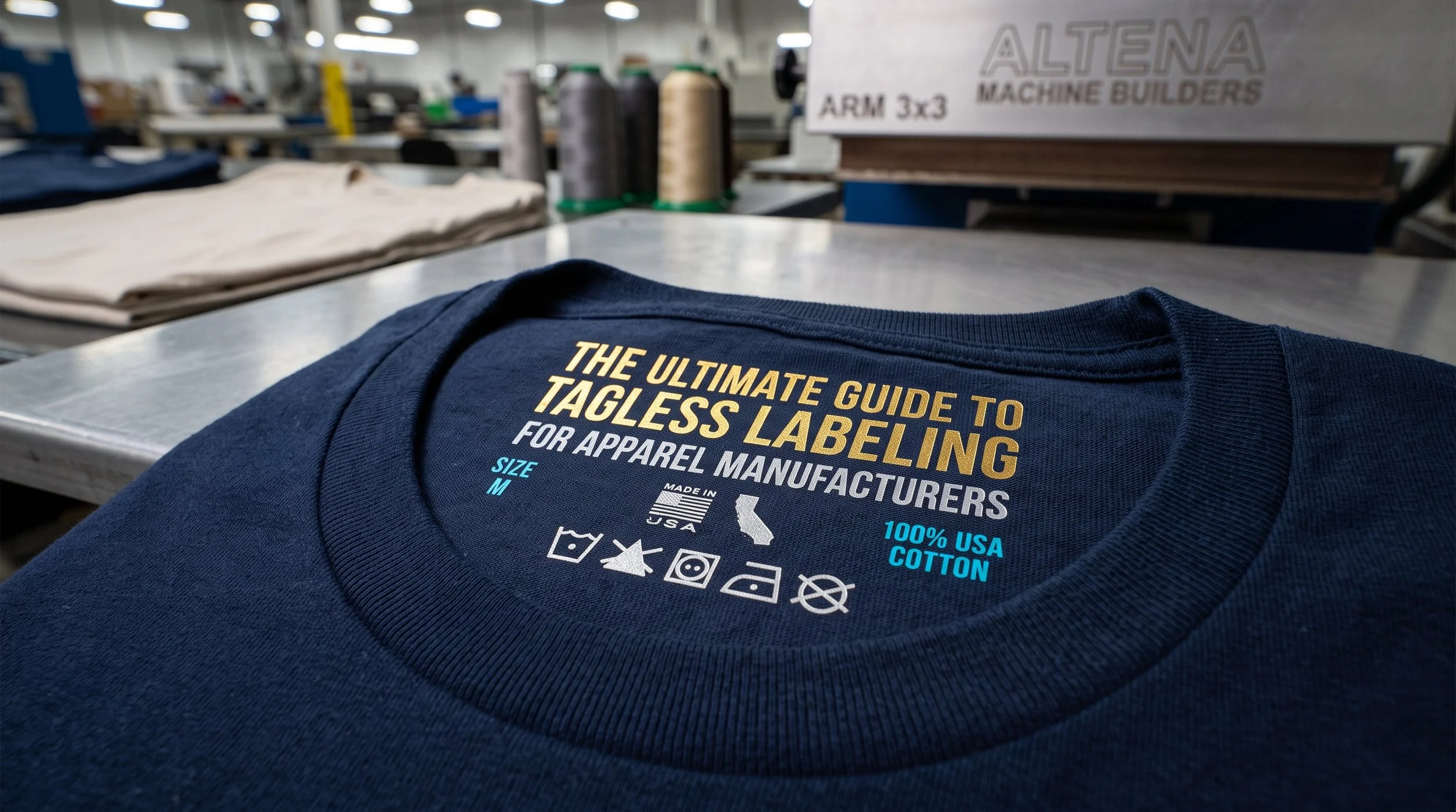
The apparel industry is unforgiving. Margins are razor-thin, production timelines are tight, and consumer expectations have never been higher. Among the many shifts in garment manufacturing over the past two decades, one of the most universally adopted is the transition from woven neck tags to tagless labeling.
What began as a premium feature in high-performance activewear has evolved into an absolute baseline expectation across nearly all garment categories—from t-shirts and intimates to infant wear and high-fashion basic apparel. Consumers simply no longer tolerate the scratchy, irritating woven labels of the past. For apparel manufacturers, however, the transition to tag-free neck labels is about much more than consumer comfort; it is a critical opportunity to streamline production, reduce material costs, and elevate brand presentation.
Upgrading to the right tagless printing setup can transform a sluggish assembly line into a highly profitable, high-volume production powerhouse. In this definitive guide, we will explore the mechanics of tagless labeling, compare the dominant application methods, break down the economics of high-volume printing, and explain why choosing the right machinery is the most important decision a facility can make.
The Evolution of Apparel Branding and the Tag-Free Revolution
Historically, the only way to brand a garment and provide federally mandated care instructions (such as fiber content, country of origin, and wash instructions) was to sew in a woven or printed fabric label. While effective for compliance, this method introduced several bottlenecks into the manufacturing process. It required sourcing labels, managing label inventory across multiple sizes and styles, and adding an entirely separate sewing step to the production line.
When tagless labeling entered the mainstream market in the early 2000s, it fundamentally disrupted this workflow. By applying the ink directly to the fabric, manufacturers bypassed the sewing process entirely. Today, driven by the booming activewear and athleisure markets, tagless labels are standard. Comfort-driven design is a primary purchasing factor for modern apparel consumers; if a garment scratches the back of a customer's neck, brand loyalty is instantly compromised. Furthermore, regulatory bodies like the Consumer Product Safety Commission (CPSC) enforce strict rules regarding the legibility of care and tracking information—something tagless printing handles with ease.
Understanding the Mechanics: What is Tagless Labeling?
At its core, tagless labeling is the process of transferring a 2D image (usually a brand logo, sizing information, and care instructions) directly onto the inside fabric of a garment. While there are several ways to achieve this, the industry standard for high-volume, high-quality production is pad printing.
Pad printing is an indirect photogravure process. Here is how it works on the factory floor:
The Cliché (Plate): The desired image is laser-etched or chemically etched into a flat printing plate, known as a cliché.
Inking: An ink cup containing specialized apparel ink slides across the cliché. It deposits ink into the etched image and wipes the flat, non-image surface clean using a hardened ceramic ring.
The Transfer: A soft, contoured silicone pad descends, pressing onto the cliché. Because the ink is temporarily exposed to the air, its surface becomes tacky, allowing it to stick to the silicone pad.
The Application: The pad lifts, moves over the garment, and presses down. The contour of the pad allows it to compress and roll onto the fabric, depositing the ink cleanly into the fibers of the garment.
The result is a crisp, opaque, and highly durable print with an incredibly soft "hand" (the feel of the print on the fabric).
The Big Three: Pad Printing vs. Heat Transfer vs. Screen Printing
When manufacturers decide to go tagless, they typically evaluate three primary methods: Heat Transfers, Screen Printing, and Pad Printing. Understanding the operational differences between these technologies is crucial for scaling your business.
1. Screen Printing
Screen printing involves pushing ink through a woven mesh stencil directly onto the garment.
The Pros: Capable of highly opaque, multi-color prints.
The Cons: Screen printing is messy and requires significant setup time. More importantly, it requires long drying times or large, energy-consuming conveyor dryers. For a simple neck label, the footprint and operational cost of a screen printing setup are drastically disproportionate to the task.
2. Heat Transfers
Heat transfer labels involve printing the label information onto a carrier paper or film, which is then applied to the garment using a commercial heat press.
The Pros: Excellent for incredibly complex, full-color graphics. Very clean application process.
The Cons: Cost and speed. Purchasing pre-printed heat transfers is significantly more expensive per unit than wet ink. Furthermore, the application process is slow. A heat press requires a "dwell time" of roughly 10 to 15 seconds per garment to melt the adhesive, plus time to peel the carrier sheet. Over an 8-hour shift, this bottleneck severely limits production capacity. Additionally, heat transfers can leave a visible "halo" of adhesive and can crack or peel after repeated washings.
3. Pad Printing (The Ultimate Solution for High-Volume)
Pad printing was engineered specifically for speed, precision, and cost-efficiency.
The Pros: Pad printing boasts an astonishingly fast cycle time. A skilled operator can print a garment every 2 to 3 seconds. The cost per print is a fraction of a cent, as a single liter of ink can yield hundreds of thousands of impressions. Furthermore, pad printing ink dries to the touch almost instantly, requiring no massive conveyor dryers.
The Cons: Switching between label sizes requires changing the cliché plate (though with modern machinery, this takes mere minutes).
For facilities producing thousands of garments a day, pad printing is the only logical choice. It maximizes throughput, minimizes per-unit cost, and delivers the soft-touch quality consumers demand.
The Business Case: Economics and ROI of High-Volume Pad Printing
To truly understand the value of tag-free pad printing, we must look at the economics. Transitioning from sewn-in tags or heat transfers to in-house pad printing dramatically alters your Return on Investment (ROI).
Drastic Cost Reduction
A standard heat transfer label can cost anywhere from $0.05 to $0.15 per unit, depending on volume and colors. If your facility produces 50,000 garments a week, you are spending up to $7,500 weekly just on label materials.
In contrast, the cost of pad printing ink, solvent, and plate wear breaks down to roughly $0.002 per print. That same 50,000 garment run costs approximately $100 in consumables. The machinery pays for itself in a matter of months, if not weeks.
Inventory Simplification
When using woven tags or heat transfers, manufacturers must forecast and stock exact quantities of labels for every size (S, M, L, XL, etc.) and every variation. This ties up capital in label inventory. With pad printing, your "inventory" is simply blank plates and liquid ink. When you need to switch from printing Mediums to Larges, you simply swap the cliché plate—a process that takes an operator less than two minutes.
Compliance and Washability
Apparel inks used in pad printing are engineered to bond with natural and synthetic fibers. When properly cured, they easily meet the rigorous wash-fastness standards set by organizations like the American Association of Textile Chemists and Colorists (AATCC). This ensures your brand logo and mandatory care instructions remain legible for the life of the garment.
Scaling Production: Choosing the Right Machinery
The success of your tagless operation hinges entirely on the quality of your equipment. A cheap, poorly engineered machine will cost you exponentially more in downtime, wasted garments, and maintenance headaches than you save on the initial purchase price.
When configuring a high-volume production floor, you must match the machine's capabilities to your specific print area requirements. Altena Machine Builders has engineered a specific lineup of pneumatic pad printers designed exclusively for the rigors of the apparel industry.
Small Format: The Neck Label Standard
For standard t-shirts, intimates, and basic activewear, the label footprint is relatively small. You need a machine that is lightning-fast and highly efficient.
The Altena ARM 3x3: This is the workhorse of the tagless industry. Featuring a 3" x 3" print area, it is perfectly sized for standard neck labels. It cycles incredibly fast, allowing operators to achieve maximum daily throughput with minimal fatigue.
Medium Format: Extended Care Instructions and Branding
As brands move toward including more storytelling, robust care instructions, or multi-lingual compliance text on their interior labels, the required print area expands.
The Altena ARM 5x5 and ARM 5x7: These machines offer expanded ink cups and larger cliché capacities. They are ideal for activewear brands that print larger interior graphics, or manufacturers who need to consolidate complex legal and care text into a single, highly legible print without sacrificing cycle speed.
Large Format: Performance Wear and Exterior Graphics
Sometimes, pad printing moves beyond the inside of the neck. For printing logos on the thighs of yoga pants, the chest of performance shirts, or large interior panels, a massive print area is required.
The Altena ARM 6x9: Offering an expansive 6" x 9" print area, this heavy-duty machine allows manufacturers to utilize the pad printing process for large-scale branding, replacing what would traditionally require a cumbersome screen-printing setup.
The Human Element
Not every facility requires immediate automation. For prototyping, boutique runs, or facilities just transitioning to tagless, Altena's Manual Machines offer the same precision engineering without the need for compressed air, allowing for ultimate control and easy training.
The Altena Advantage: Why USA-Made Manufacturing Matters
In the world of industrial machinery, origin matters. The market is currently flooded with cheap, imported pad printing machines. While the upfront price tag may look appealing to a procurement officer, production managers know the painful reality: when an imported machine goes down, production stops.
Waiting weeks for replacement parts to ship from overseas, struggling with poorly translated instruction manuals, and dealing with nonexistent customer support are hidden costs that destroy profitability.
This is where Altena Machine Builders changes the paradigm. We don't just assemble machines; we build them from the ground up in our manufacturing facility in the Midwest. When you invest in an Altena machine, you are investing in:
Supply Chain Reliability: Because our machines are built in the USA, our parts are stocked in the USA. If you ever need a replacement component, it ships immediately, minimizing your downtime.
User-Friendly Touch Screens: The modern factory floor requires intuitive equipment. Altena machines feature advanced, user-friendly touch screens that allow operators to adjust stroke depth, dwell time, and print speed with a tap. This drastically reduces operator training time and eliminates the frustrating mechanical tweaking required by older equipment.
Low-Maintenance, High-Volume Engineering: Our machines are over-engineered for the realities of a 24/7 production cycle. We use premium pneumatic cylinders, aircraft-grade aluminum, and precision-machined components. They are designed to run continuously, day in and day out, with minimal maintenance.
Best Practices for Seamless Tagless Production
To maximize the output of your Altena machinery, your production floor should adhere to a few core best practices:
Master Your Ink Chemistry: Pad printing ink requires a solvent (thinner) and, depending on the fabric, a hardener (catalyst) to ensure maximum adhesion to synthetic fabrics like polyester or nylon. Train operators to monitor the ink viscosity throughout their shift. A quick splash of thinner every few hours keeps prints crisp and opaque.
Optimize the Workspace Ergonomics: Pad printing is incredibly fast, but the machine can only run as fast as the operator can load and unload the garments. Set up your workstations so that blank garments are easily within reach of the operator's left hand, and a bin for finished garments is immediately to their right.
Conduct Regular Adhesion Testing: Before running a large order on a new fabric blend, always run a test print. Wait 24 to 48 hours for the ink to fully cross-link and cure, and then subject the garment to a wash-and-stretch test to ensure adherence to safety and quality board standards.
Conclusion: Take Control of Your Production Line
The transition to tagless labeling is no longer a luxury; it is an industry mandate. Consumers demand comfort, and competitive pricing models demand efficiency. By moving away from slow heat transfers and cumbersome sewn-in tags, you immediately strip out unnecessary material costs and labor bottlenecks.
However, recognizing the need for pad printing is only half the battle. Executing it efficiently at scale requires machinery that is as relentless and reliable as your production schedule. By choosing USA-made equipment tailored for high-volume manufacturing, you insulate your facility from supply chain disruptions, reduce operator errors via intuitive touch screen controls, and ensure your lines keep moving.
Whether you are printing small neck labels on cotton tees or large branding graphics on performance poly-blends, Altena Machine Builders has the specific equipment to optimize your floor. Stop losing money on slow processes and unreliable imported machines.
Take the next step in scaling your apparel manufacturing business. Reach out to our team of experts in California today to discuss your specific production needs, fabric types, and volume requirements.
Click here to Get a Custom Quote and discover the Altena difference.